
Doubting Thomas Sunday School Lesson for Kids
A free Doubting Thomas Sunday school lesson (John 20:19–31) in four age levels, preschool to preteen, with a game, Bible story, questions and a take-home.
Preschool–Grade 6
Download
- ⬇ Teacher lesson, kindergarten to 2nd grade (PDF) · 4 pages
- ⬇ Teacher lesson, preschool ages 3–5 (PDF) · 3 pages
- ⬇ Teacher lesson, 3rd to 5th grade (PDF) · 4 pages
- ⬇ Teacher lesson, preteens ages 11–12 (PDF) · 4 pages
- ⬇ Take-home sheet (PDF) · 1 page
Free to print and copy for your church, classroom, VBS and home. Please don't resell or re-post our files; link to the page instead.
- Ages
- Preschool (3–5), Early Elementary (K–2), Upper Elementary (3–5), Preteen (5–6)
- Time
- 20–60 minutes (depends on the age level)
- Scripture
- John 20:19–31
- Bible story
- Thomas Sees Jesus
What you need
- A Bible (mark John 20:19 and John 20:29)
- Bibles for the kids to look up verses (3rd grade and up)
- 6 paper strips, a marker and tape (memory verse game, kindergarten to 2nd grade)
- A small toy or object and a paper bag (opening game, kindergarten to 2nd grade)
- Masking tape to make a "door" line on the floor (preschool to 2nd grade)
- A whiteboard or large paper and a marker (3rd grade and up)
- Paper and pencils (preteens)
- Printed take-home sheets, one per child
- Printed Doubting Thomas word search and crayons for early finishers
This free Doubting Thomas Sunday school lesson teaches kids that Jesus is alive and that we can believe in Him: when Thomas saw the risen Jesus, he said, "My Lord and my God" (John 20:28), and Jesus said, "blessed are they that have not seen, and yet have believed" (John 20:29). It comes in four age levels, each a separate printable teacher lesson, plus one take-home sheet for families. Pick the one that fits your class. Everything is in the order you teach it.
Choose your age level
- Preschool (ages 3–5), 20–30 minutes, 3 pages: a shut-the-door game, a short story with hand motions and repeat-after-me lines, three simple questions, a shortened memory verse ("blessed are they that have not seen, and yet have believed") with motions, and a shut-door-and-heart drawing.
- Kindergarten to 2nd grade, 45 minutes, 4 pages: the We Saw It! guessing game, the story in simple words, five recall questions with answers, the Six Strips memory verse game, and a through-the-door review game.
- 3rd to 5th grade, 45–60 minutes, 4 pages: an eyewitness game, kids look up verses in their own Bibles during a fuller story ("Receive ye the Holy Ghost," "My Lord and my God," why John wrote his book), five thinking questions and three recall questions, and a Bible look-up race about Thomas.
- Preteens (ages 11–12), 45–60 minutes, 4 pages: students read John 20:19–31 and John 14:5–9 out loud themselves, then discuss honest questions, faith without sight, and who Jesus is. Six discussion questions, a journal page, and two memory verses (John 20:29 and John 20:31).
Lesson at a glance
- Bible passage: John 20:19–31 (with John 14:5–9, Luke 24:36–49 and Acts 1:1–14)
- Main point: Jesus is alive! Thomas saw Jesus and believed. We have not seen Jesus, but we can believe in Him too.
- Memory verse: John 20:29 (KJV), with John 20:31 added for preteens
- Ages: preschool to preteen, in four versions
Lesson outline (the same in every version)
- Opening game: a short game about seeing, believing or eyewitnesses.
- Bible story: the disciples behind shut doors, Jesus stands in the midst and says "Peace be unto you," Thomas is not there, eight days later Jesus comes again, and Thomas says "My Lord and my God." Every fact has its verse reference so you can check it.
- Questions to ask: with answers, at the right level for each age.
- Memory verse: a game or motions to help kids learn John 20:29.
- What this means for us: believing in Jesus without seeing Him, the gospel (Acts 2:38), and a challenge for the week.
- Activity: the Doubting Thomas word search, crossword, maze, worksheet, the Doubting Thomas craft, a through-the-door game, a Bible look-up race or a journal page, depending on the age.
- Prayer.
Tips for teaching Doubting Thomas
- Read John 20:28 straight from your Bible. Thomas called Jesus "My Lord and my God," and Jesus accepted it. There is one God (Deuteronomy 6:4), and Jesus is God manifest in the flesh (1 Timothy 3:16).
- Tell the hands and side gently, the way the text does (John 20:20, 25, 27). The Bible doesn't say Thomas touched Jesus; Jesus said Thomas believed because he had seen Him (20:29).
- "Receive ye the Holy Ghost" (John 20:22): every level ties it to the promise Jesus gave and to the day of Pentecost, when the disciples, Thomas among them, were filled with the Holy Ghost and spoke with other tongues (Acts 1:13; 2:4).
- Short on time? Do the story, three questions and the memory verse. That is a solid 25-minute lesson.
Frequently asked questions
How long does this Doubting Thomas lesson take?
It depends on the age level. The preschool lesson takes 20 to 30 minutes, the kindergarten to 2nd grade lesson about 45 minutes, and the 3rd to 5th grade and preteen lessons 45 to 60 minutes. For a short class, do the story, three questions and the memory verse.
What is the main point of the Doubting Thomas story for kids?
Jesus is alive, and we can believe in Him. Thomas said he would not believe unless he saw Jesus for himself (John 20:25). When Jesus came, Thomas said, "My Lord and my God" (John 20:28). Jesus said, "blessed are they that have not seen, and yet have believed" (John 20:29). That means us!
What does "My Lord and my God" mean for kids?
When Thomas saw Jesus alive, he called Jesus his Lord and his God (John 20:28), and Jesus told him he had believed (20:29). There is one God (Deuteronomy 6:4), and Jesus is God who came to earth as a man (1 Timothy 3:16). Thomas knew who Jesus really is.
What did Jesus mean when He said "Receive ye the Holy Ghost"?
Jesus breathed on His disciples and said, "Receive ye the Holy Ghost" (John 20:22). He had promised them the Holy Ghost, and He told them to wait in Jerusalem for it (Luke 24:49; Acts 1:4–5). On the day of Pentecost they were all filled with the Holy Ghost and spoke with other tongues (Acts 2:4).
More for this Bible story
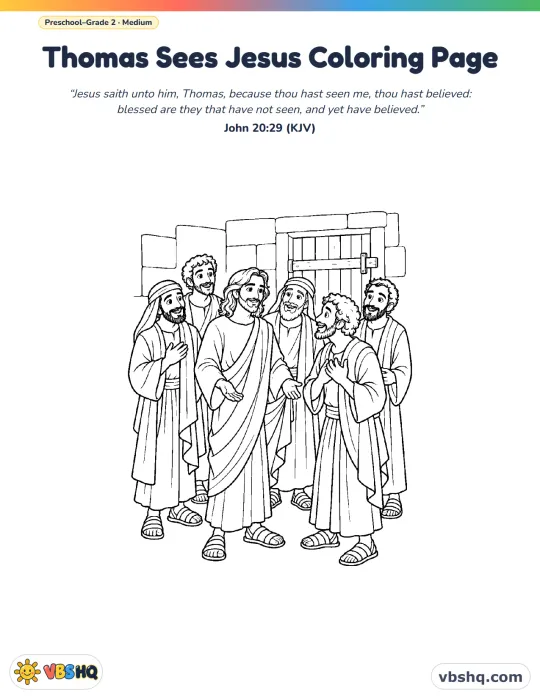 Coloring Page
Doubting Thomas Coloring Page (Free Printable)
Preschool–Grade 2 · Medium
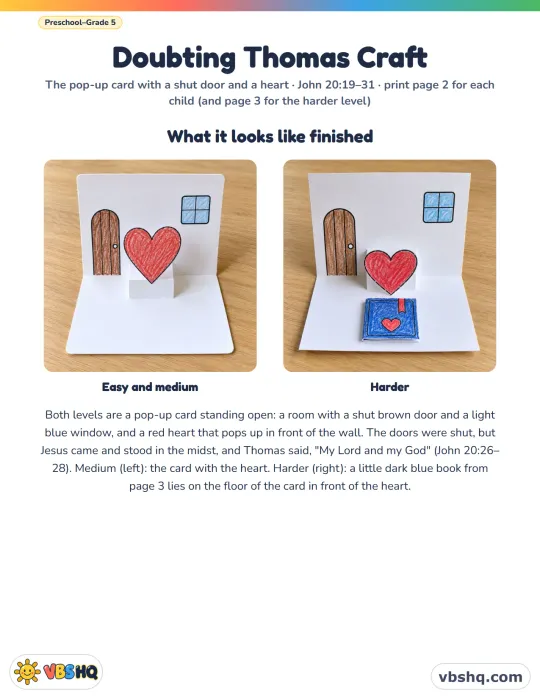 Craft
Doubting Thomas Craft for Kids
Preschool–Grade 5
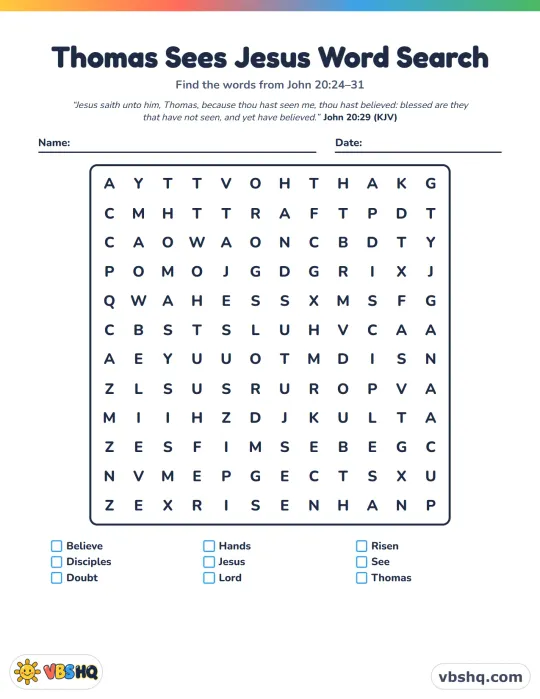 Word Search
Doubting Thomas Word Search for Kids (Easy, Medium and Hard)
Preschool–Grade 5 · Medium
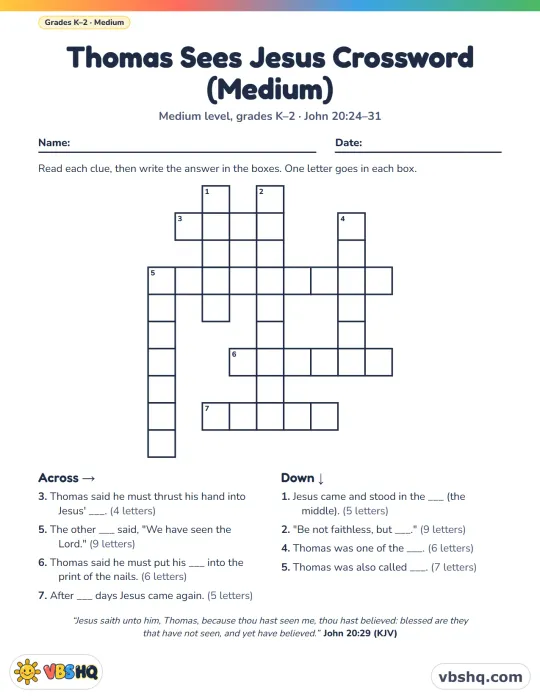 Crossword
Doubting Thomas Crossword for Kids (Easy, Medium and Hard)
Grades K–5 · Medium
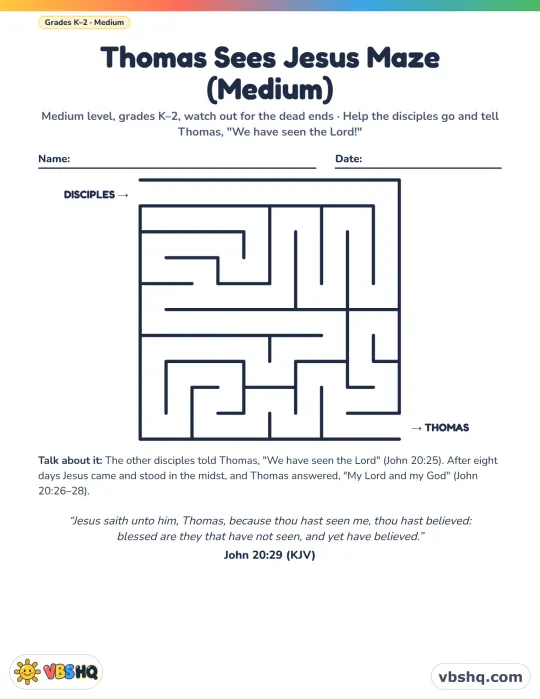 Maze
Doubting Thomas Maze for Kids (Easy, Medium and Hard)
Preschool–Grade 5 · Medium
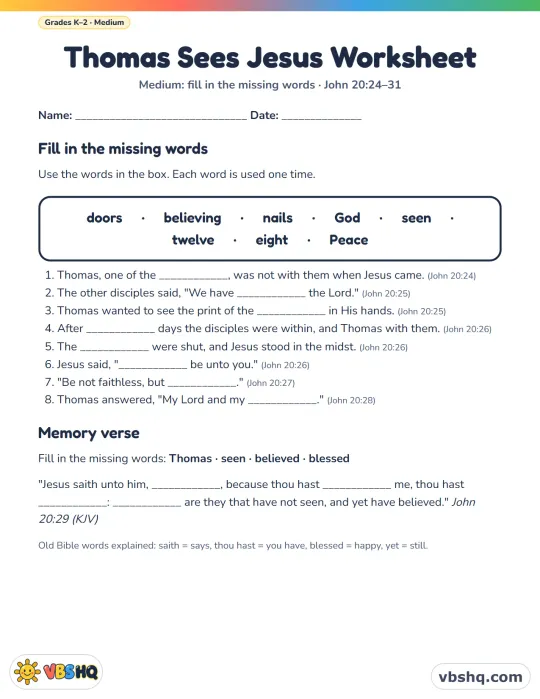 Worksheet
Doubting Thomas Worksheet for Kids (Easy, Medium and Hard)
Preschool–Grade 5 · Medium