Queen Esther Sunday School Lesson for Kids
A free Esther Sunday school lesson (Book of Esther) in four age levels, preschool to preteen, with a game, Bible story, questions, memory verse and take-home.
Preschool–Grade 6
Download
- ⬇ Teacher lesson, kindergarten to 2nd grade (PDF) · 4 pages
- ⬇ Teacher lesson, preschool ages 3–5 (PDF) · 3 pages
- ⬇ Teacher lesson, 3rd to 5th grade (PDF) · 5 pages
- ⬇ Teacher lesson, preteens ages 11–12 (PDF) · 5 pages
- ⬇ Take-home sheet (PDF) · 1 page
Free to print and copy for your church, classroom, VBS and home. Please don't resell or re-post our files; link to the page instead.
- Ages
- Preschool (3–5), Early Elementary (K–2), Upper Elementary (3–5), Preteen (5–6)
- Time
- 20–60 minutes (depends on the age level)
- Scripture
- Esther 1–10
- Bible story
- Queen Esther
What you need
- A Bible (mark Esther 4:14 and Esther 5:2)
- Bibles for the kids to look up verses (3rd grade and up)
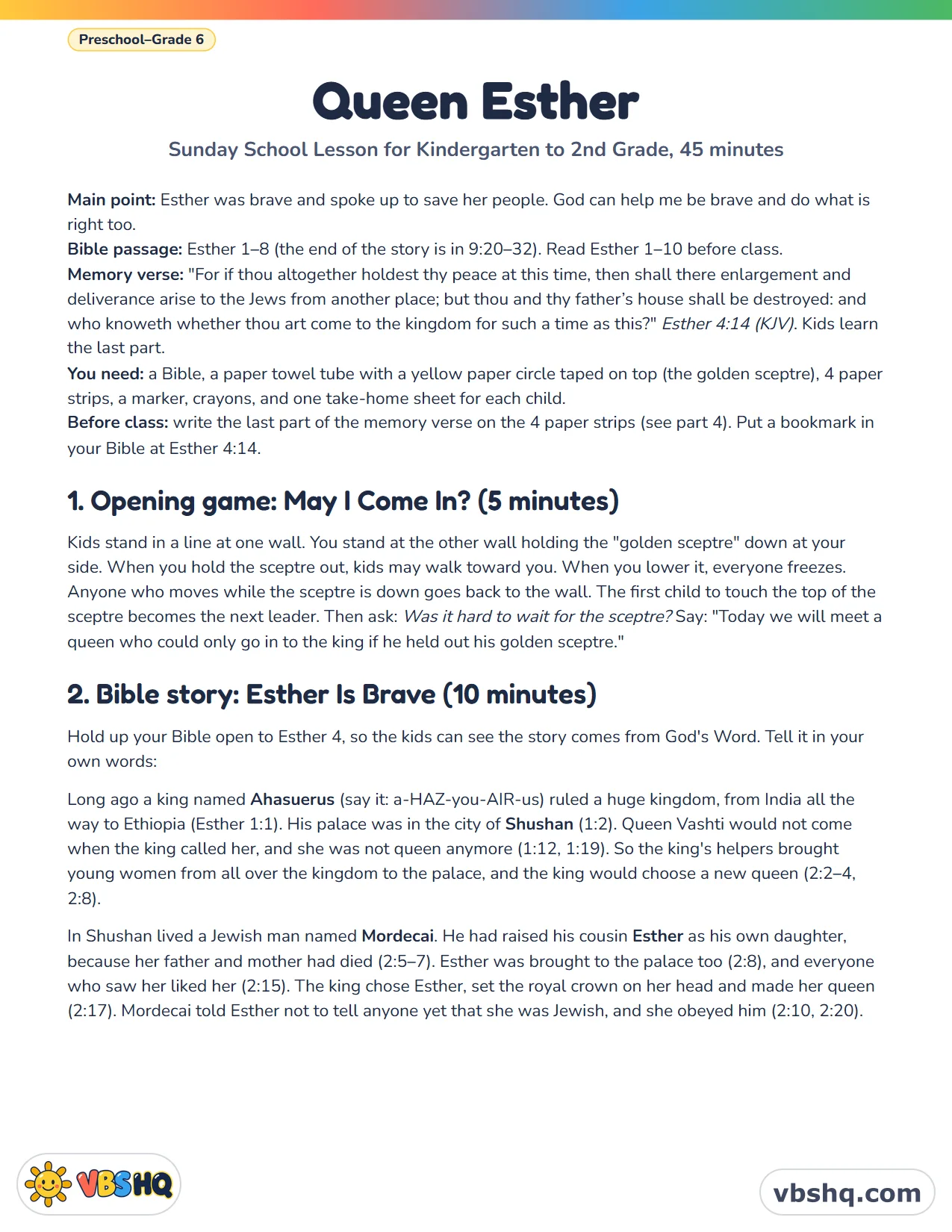
- A paper towel tube with a yellow paper circle taped on top, to be the golden sceptre (preschool and kindergarten to 2nd grade)
- 4 paper strips and a marker (memory verse game, kindergarten to 2nd grade)
- A long strip of paper (or 3 sheets taped end to end) and a marker (memory verse scroll, 3rd to 5th grade)
- A whiteboard or large paper and a marker (3rd grade and up)
- Paper and pencils (preteens)
- Printed take-home sheets, one per child
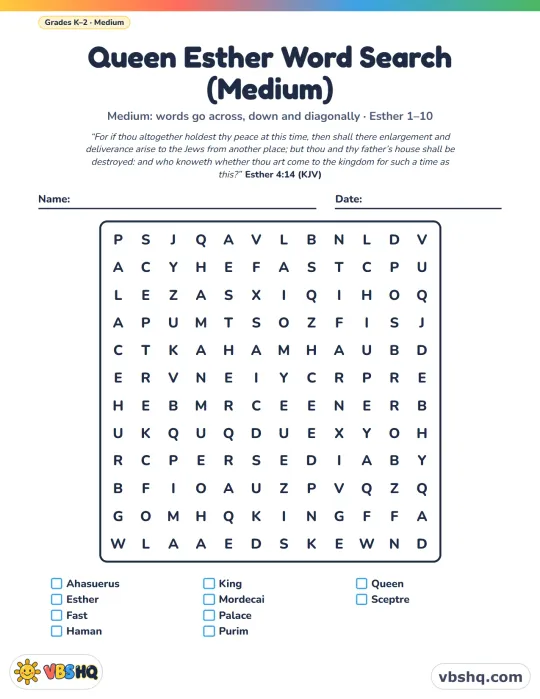
- Printed Esther word search and crayons for early finishers
This free Esther Sunday school lesson teaches kids courage to do right and stand up for others: Queen Esther fasted, went in to the king without being called and spoke up to save her people, saying, "If I perish, I perish" (Esther 4:16). It comes in four age levels, each a separate printable teacher lesson, plus one take-home sheet for families. Pick the one that fits your class. Everything is in the order you teach it.
Choose your age level
- Preschool (ages 3–5), 20–30 minutes, 3 pages: a hunt for the king's golden sceptre, a short story with hand motions and repeat-after-me lines, three simple questions, a shortened memory verse ("for such a time as this") with a motion, and a touch-the-sceptre activity.
- Kindergarten to 2nd grade, 45 minutes, 4 pages: the May I Come In? game, the story in simple words, five recall questions with answers, the Sceptre Verse game with four paper strips, and an honor parade from Esther 6.
- 3rd to 5th grade, 45–60 minutes, 5 pages: kids look up verses in their own Bibles during a fuller story (Mordecai saves the king, Haman's plan and Pur, "such a time as this," the golden sceptre, the sleepless night, the new letters and Purim), five thinking questions and three recall questions, a rolling scroll verse game and a Bible look-up race.
- Preteens (ages 11–12), 45–60 minutes, 5 pages: a "Speak up or stay quiet?" opening, students read Esther 4:1–17 and 8:3–8 out loud themselves, then discuss courage, God working when His name isn't mentioned, and pride. Six discussion questions, a journal page, and two memory verses (Esther 4:14 and Joshua 1:9).
Lesson at a glance
- Bible passage: Esther 1–10
- Main point: Esther was brave and spoke up to save her people. God can help me be brave, do right and stand up for others.
- Memory verse: Esther 4:14 (KJV), with Joshua 1:9 added for preteens
- Ages: preschool to preteen, in four versions
Lesson outline (the same in every version)
- Opening game: a short game about waiting for the king's sceptre, passing a message, or speaking up.
- Bible story: Esther becomes queen, Mordecai saves the king, Haman's wicked plan, "for such a time as this" (Esther 4:14), three days of fasting, the golden sceptre (5:2), the king's sleepless night, Esther names Haman, and the new letters that saved her people. Every fact has its verse reference so you can check it.
- Questions to ask: with answers, at the right level for each age.
- Memory verse: a game or motion to help kids learn Esther 4:14.
- What this means for us: courage to do right, the gospel (Acts 2:38), and a challenge for the week.
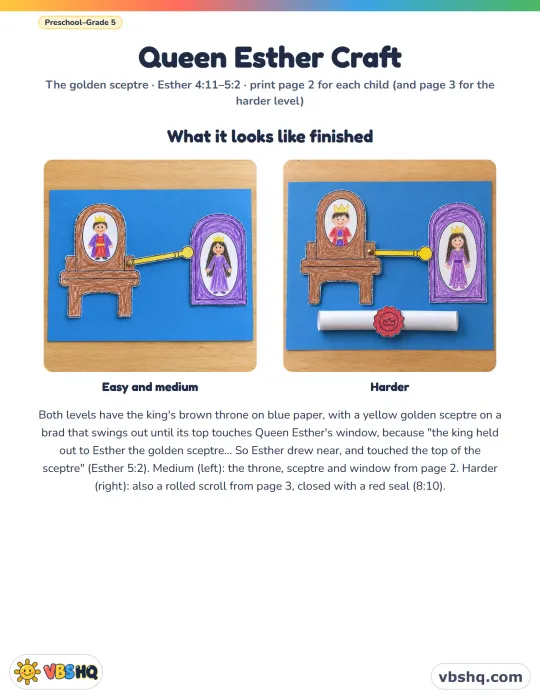
- Activity: the Esther word search, the Esther crossword, the Esther maze, the Esther worksheet, the Esther craft, a Bible look-up race or a journal page, depending on the age.
- Prayer.
Tips for teaching Esther
- Read Esther 4:14 and 4:16 straight from your Bible. They are the heart of the story: "for such a time as this" and "if I perish, I perish."
- Get the family right: Mordecai was Esther's cousin, not her uncle. She was "his uncle's daughter," and he raised her as his own daughter (Esther 2:7).
- The choosing of a new queen is told in a sentence or two (2:2–17), Haman's end (7:10) is told briefly and gently, and the fighting in chapter 9 is left out of the story. Each level has short teacher notes in case a child asks.
- The book of Esther never uses the word "God." The lessons don't add words to anyone's mouth; they let kids notice the fasting, Mordecai's words and the king's sleepless night.
- Short on time? Do the story, three questions and the memory verse. That is a solid 25-minute lesson.
Frequently asked questions
How long does this Esther lesson take?
It depends on the age level. The preschool lesson takes 20 to 30 minutes, the kindergarten to 2nd grade lesson about 45 minutes, and the 3rd to 5th grade and preteen lessons 45 to 60 minutes. For a short class, do the story, three questions and the memory verse.
What is the main point of the story of Esther for kids?
Courage to do right and stand up for others. Esther could have stayed quiet, but she fasted, went in to the king without being called and spoke up to save her people, saying, "If I perish, I perish" (Esther 4:16).
Was Mordecai Esther's uncle or her cousin?
Her cousin. The Bible says Esther was "his uncle's daughter," and Mordecai raised her as his own daughter after her father and mother died (Esther 2:7).
Is the story of Esther OK for young kids?
Yes, told the way this lesson tells it. The choosing of a new queen is told in one or two plain sentences (Esther 2:2–17), Haman's end (7:10) is told briefly and gently, and the fighting in chapter 9 is left out of the story. Every level has short teacher notes in case a child asks.